
The Property Market Has Changed


The Property Market Has Changed. Has Your Strategy?
Another interest rate rise has understandably created uncertainty.
For some investors, it has created hesitation.
But the property market has never been as simple as looking at the cash rate and deciding whether to buy or wait.
The reality is that the market is becoming more complex.
Construction costs remain elevated. Land supply is under pressure. Planning and infrastructure requirements continue to influence what can be delivered, where it can be delivered and how quickly.
And while governments are working to unlock more housing supply, the process of bringing land from potential supply to completed homes is not immediate.
The Supply Problem Runs Deeper Than Interest Rates
The cost of building a new home remains significantly higher than it was before COVID.
The National Housing Supply and Affordability Council reported that house construction costs increased another 2% in the June quarter of 2026 and are now 51% higher than before the pandemic and associated supply chain disruptions. The Council also noted that increasing construction costs may reduce the financial feasibility of some housing projects and that recent interest rate increases are likely to see some construction deferred.
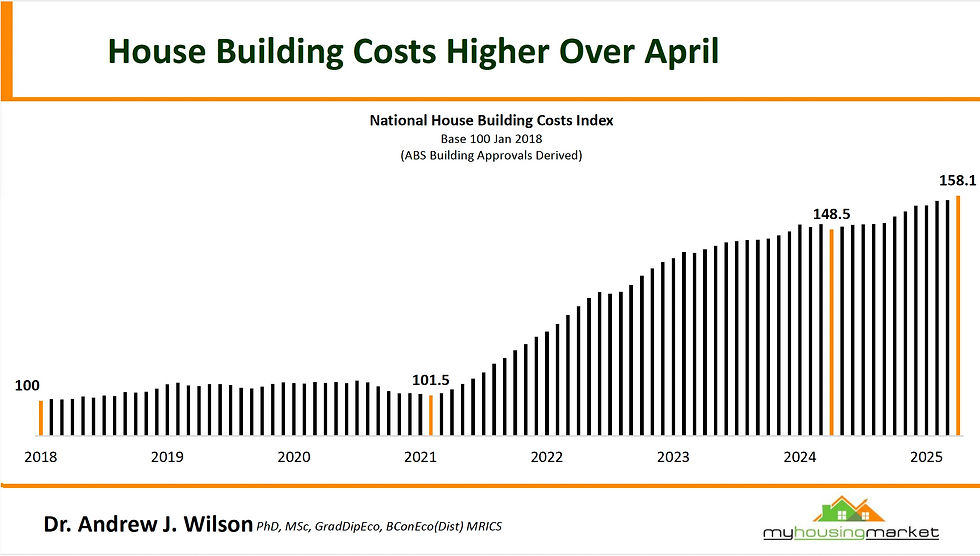
At the same time, getting new housing into the market involves far more than simply having land available.
Queensland's latest data illustrates the pressure within the pipeline. Total dwelling approvals fell 13.9% in July, while private-sector house approvals fell 5.5%.
The Queensland Government is responding with initiatives designed to unlock land, fund enabling infrastructure and streamline planning and building processes, including the Residential Activation Fund, Land Activation Program and Queensland Housing Code.
These initiatives are important.
But they also highlight the underlying issue.
Creating more housing supply is a process, not a switch.
A Changing Tax Landscape
From 1 July 2027, changes to negative gearing and capital gains tax will create a significant distinction between new and established residential property. Eligible new builds will retain access to negative gearing, while established properties purchased after 12 May 2026 will no longer receive the same ability to offset rental losses against non-residential income such as salary.
New builds will also retain the option to use the existing 50% CGT discount, while established property will move to the new inflation-based treatment.
These reforms are designed to encourage investment into new housing supply rather than further competition for established homes. For investors, the distinction between what you buy is becoming increasingly important.
With Calla Property specialising in new property for years, our experience, industry recognition and longstanding builder and vendor relationships place us at the forefront of this changing landscape.
That doesn't mean every new property is a worthwhile investment.
It means the quality of the investment selection matters more than ever.
A new property needs to stack up across the fundamentals:
Population.
Location.
Infrastructure.
Employment.
Rental demand.
Supply and future competition.
Construction quality.
Cash flow and serviceability.
Risk factors like flood, fire and crime.
Good Markets Still Produce Bad Investments
This is perhaps the most crucial point. Investors don't only make mistakes when markets are difficult.
They make mistakes when markets are easy, too.
A favourable financial environment doesn't automatically make a property a good investment.
The property itself still matters.
That's why having an experienced team around you is so important.
This Is Where Calla Property Comes In
At Calla Property, we have spent years specialising in new property and developing relationships throughout the industry.
Our experience, industry recognition and longstanding relationships with builders and vendors give us access to knowledge and opportunities that extend well beyond simply finding a property.
We understand that your investment strategy needs to change as your life changes. The property that makes sense when you're building your first investment portfolio may not be the property that makes sense when you're preparing for retirement.
That is why our role is to help you build a property strategy around your life.
The Calla Property Takeaway
There will always be reasons to wait.
But there will also always be opportunities that exist within those conditions.
The challenge is knowing the difference between a genuine risk that should change your strategy and temporary uncertainty that shouldn't stop you from pursuing it. That's where expertise matters.
You don't need to predict the market perfectly.
You need a strategy built around sound research, quality property and your own long-term objectives.
Because the goal isn't to find a perfect market.
It's to make sound investment decisions in every market.
If you're unsure what the current environment means for your property strategy, hit reply.
Let's look at where you are today, where you want to be tomorrow and what the right investment strategy could look like in between.
The information contained in this article is provided for general information purposes only and does not constitute financial advice, investment advice, or a recommendation by Calla Property. Past performance is not a guarantee of future results, and no guarantees or representations are made regarding the outcomes of any investment or property decision. Readers should seek independent financial, legal and/or professional advice before making any decisions. Calla Property accepts no responsibility or liability for any decisions made by clients or readers based on the information provided or for any outcomes arising from those decisions.
+61 485 976 989 | +61 468 190 823 | +61 482 080 189
Plan with clarity. Move with purpose.


Comments